Bryan Joiner

Why then I

Category: new york

Where are our cathedrals?

Thanks to MPdSP, I’ve hooked on to Tony Judt’s memoirs at NYRB (I own an e-subscription, so it’s just as well). In the most recent issue, he writes about riding the railroads around Europe in his youth, in awe of the train stations:

At their best—from St. Pancras to Berlin’s remarkable new central station—railway stations are the very incarnation of modern life, which is why they last so long and still perform so very well the tasks for which they were first designed. As I think back on it—toutes proportions gardées— Waterloo did for me what country churches and Baroque cathedrals did for so many poets and artists: it inspired me. And why not? Were not the great glass-and-metal Victorian stations the cathedrals of the age?

I’ll submit that they were. What do we have now? Certainly not airports, which is a shame because they’re the most obvious choice and the one to which many people I know have clung, tearing at the linoleum for significance in their knowledge and appreciation of O’Hare’s or Hartsfield’s concourse layouts or fast-food options. The emptiness of the airport space has been explored by many people in many forms, most popularly and recently in Up in the Air, despite its messiness. Everyone knows airports aren’t up to the aesthetic challenge of replacing train stations, and simply pointing this out does not make a great film anymore.

Are websites the new cathedrals? It seems that the answer is obviously yes but more obviously no. Certainly the rage engendered by every Facebook redesign would indicate that people have a fondness for the site that extends to the emotional: they think it’s theirs, not to be fucked with. But there’s nothing particularly aesthetically pleasing about it, nor does it function in the same way as a religious cathedral or train station. Those places are transitory by nature; you arrive, appreciate, and leave. In that way, Google would be a better corollary if it was much of a site at all. Facebook, by contrast, is designed like the world’s biggest airport you’d never want to leave — unlike Tom Hanks in The Terminal or that dude at Charles de Gaulle, they want you to live your life there. It keeps you where you are, instead of pushing you out, even if from an overload of wonder.

A friend told me that a professor once told him that the worst thing to do (one presumes as a tourist) was take a photo of the Grand Canyon. By taking the picture, you were absolving yourself of properly recording the memory, and one assumes ruining the view for anyone else who wanted to see it with fresh eyes, like the people who skip the “Scenes from Next Week’s Show”* on Lost.

* My brother and I used to watch the entirety of Beverly Hills 90210 in breathless anticipation of whether there would be “Scenes from Next Week’s Show” after the end credits. We called them “SCENES!” and would jump into the air, fists extended, when they would happen.

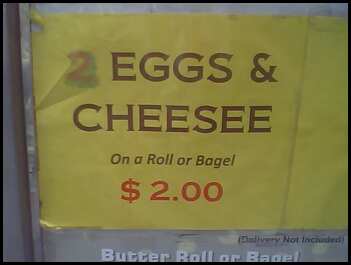
Of course, that was more than 10 years ago, and I can take a picture with my free-with-a-2 year plan phone I have now. Which I’ve done to take pictures of many things, my feet included:Also funny signs:

…and never food, but it’s only a matter of time. The point is that I use my camera to document the horribly mundane, or at least the amusing things amongst the horribly mundane ones. I also have pictures of my friend’s sixth-month old baby, which I uploaded and never showed anyone; what was the point? Did I take the picture to avoid paying real attention to her? And were the literally thousands of photos of the Grand Canyon to which my brother had been subjected make him not want to stay for more than three hours, after a treacherous four-hour drive (one way) to get there? And were the pictures I took on that trip the same reason I didn’t feel like I needed to hike into the Canyon on my return trip seven months later? Pushing further, I’ve never been to Westminster Abbey… but I know it from The Da Vinci Code. I’ve walked past Trinity Church hundreds of times, but the inside I know from National Treasure. The worst part is that even if I went inside, I’d still know it from National Treasure. It’s part of something bigger and ultimately aesthetically unspectacular (lower Manhattan), and by no means modern. The vast majority its visitors are running down a checklist, hoping to be awed… which is exactly what I would do if I was visiting. But I’d really be looking for the mundane; I’d think it was really funny, and noteworthy, if someone wrote “poop” on an official-looking sign or something.

In just my home city of New York, there are many structures that ostensibly pass as cathedrals: the Empire State Building, the Guggenheim, Yankee Stadium, the Met, Lincoln Center, the Natural History Museum, the Statue of Liberty, maybe the Tennis Center or Apollo Theater… but none of these are inspiring in the day-to-day, or even in the year-to-year. I don’t know if this is a result of American vacuousness, but if it’s not totally empty, it’s because one structure doesn’t easily top all the others. Everyone can appreciate maybe one of those places more than the other in the way they have their favorite slice of pizza or burger, and they can rhapsodize and intellectualize it all they want… but in the end, all of those discussions are really no different from one another. Awe is fleeting, but not by design.

The Brooklyn Bridge at the Magic Hour

The other night, in discussing my plan to paint the Manhattan Bridge, I took some shots at the Brooklyn Bridge in the company of a proud New Yorker. She was aghast, but I continued as if she wasn’t even there. “… and it’s not even pretty anyway!” I bellowed. “I just don’t think it’s a nice to look at as everyone says it is. They just want to like it because it’s old!”

When I was admonished by not just said woman and, well, everyone sitting around me, I refused to back down. Okay, maybe I backed down a little, retreating to my initial point about the Manhattan Bridge’s need for anything—anything—to spruce it up. On Monday, I walked across the Brooklyn Bridge, like I often do, and everything changed.

I moved to Brooklyn in March, and it was July until I realized that the walk from City Hall to my house was no more than 45 minutes, and a sure way to beat the heat with the cool breezes at the top of the bridge. The first few times I did it, I made sure to stop and soak in the view of Brooklyn, Governor’s Island, the Statue of Liberty and Lower Manhattan. I almost never looked north.

I was trying to understand what made the bridge so great. I’m not a cynic by nature as much as someone who needs to see things with his own eyes. I wasn’t seeing it yet, but I continued to walk over the bridge. I needed the exercise.

During this time, I began dating a woman who has since become the official squeeze of this blog. She often gets off work around the same time as I do, and had admonished me for never calling her before walking over the bridge (she lives nearby). Well, Monday, I finally did it, and we met at City Hall and pointed ourselves eastward, and that’s when everything clicked.

For all my thoughts that the summer was the best time to enjoy the span, I was wrong. It’s right now. The angle of the sun from 5 to 6 p.m. is just right to cast the shadows of the suspension cables across the bridge’s stanchion’s, which are also bathed in the oranges, reds and purples of the setting sun—what’s known as the “Magic Hour” to photographers. It’s majestic, and it’s only then that the size of the structure stands out. Surrounded by cables and shadows, it feels like you’re experiencing a wonder of the world (when it was opened, it was called the Eighth Wonder of the World). Here the bridge existed not as a watery tomb to those who created it but as a living, functional piece of art with no American equal. And I was finally mad at the aliens (Independence Day), tidal wave (Deep Impact) and U.S. Government (I Am Legend) for destroying it.

Yesterday, one day removed from my epiphany, I walked over the bridge again. Without the lady and the exact weather conditions, it was a touch less spectacular than the day before, so I turned my attention back to the Manhattan Bridge. There it was, in its blue-and-rust splendor, existing mostly for truckers and commuters who could do without the Brooklyn Bridge’s pomp and heightened security. One thought overwhelmed all others: it’s just too watery. The blue of the bridge mixes with the blue-green of the East River to render it mostly invisible except in those photographs from DUMBO where it perfectly frames the Empire State Building. I, like many new New Yorkers, saw that for myself about seven years ago and thought I had discovered something amazing. Like my recent discovery of the majesty of the Brooklyn Bridge, it just showed I had a lot to learn.

My initial proposal was to paint the bridge brown, but I think I’ve grown attached to one by a friend who left it in the comments here: paint it beige, and train lights on it a la the Empire State Building. Change the colors nightly. The bridge would become a living piece after sundown, keeping the magic alive after its little brother’s breathtaking show at the dusk.

Atlantic Antics

Yesterday was the Atlantic Antic street fair along Atlantic Avenue in Brooklyn. I know because I live a block away from Atlantic Avenue, and took in the sights and sounds of the event, which stretched for a good mile and a half or so. The temperature was in the upper sixties, and the sky was cloudless. It was a perfect day for a stroll.

Barely had I gotten there when I was yelled at about America’s involvement in Afghanistan. “We need to spend money where it REALLY belongs—on health care!” a guy yelled while failing to hand out fliers. No one was engaging him, despite his best efforts and one presumes the crowd’s general agreement. It’s one thing to read Frank Rich, it’s another to engage the maniacal guy at Atlantic and Boerum. How very un-Rich like that would be.

It was at this point that I noticed I was walking behind supporters of Bill Thompson, the comptroller who is running for mayor. There were two of them holding placards aloft, yelling “Bill Thompson for mayor!” This being a big event in a part of the town that could skew anti-Bloomberg, I wondered whether the candidate was leading the group himself, but he wasn’t—it was just those two, who received almost the same response as Mr. Afghanistan until someone yelled in passing, “Bill Thompson! That’s my man right there!”

By the time I got to Court Street, I was thinking about where exactly I was going to watch the Giants game when I came across a makeshift stage, constructed by the Parks department. There, a group of people were playing Middle Eastern music, and about a hundred people stood watching. “Stay here!” the MC urged. “Our first dancer is coming up right now!” He referred to her by name, which I have forgotten but remember had a real-world double meaning. We’ll call her Joy. Two minutes later, Joy was on stage dancing to the music. She was dressed in a brightly-colored silk-and-mesh outfit and looked exactly like a transexual. The crowd ate it up. I turned to leave.

Along the sidewalk, a man was playing a flute to accompany the music, to and for himself, in a storefront. A woman sitting in front of him shimmied to the music from the Parks Department speakers as Joy continued to swirl onstage.

I realized I was getting hungry. What to eat? There were so many choices. Most of them were standard street fair fare, like Italian sausage, french fries, fried cheese in many different forms and shish kebabs. There were several French restaurants along the route, and they hawked oysters and shrimp. There was even a crepe stand. My stomach was mostly full from the night before with spicy lamb meat, so I wasn’t tempted by the heavier stuff, though I did inquire as to the price of a falafel sandwich. I was told it was eight dollars, and resisted the urge to ask if he meant American currency.

By this point, I was almost back at my house, but I stopped to look at the offerings from the antique stores I’m too embarassed to go in. I learned very quickly that I should be saving old stuff—chairs that would be thrown out at a Queens school were fetching $600. The highlight were some high-ticket 50’s-era tin robot sculptures, which were arranged around a sign adminishing passsers by to “Please Do Not Touch the Robots.” Life lesson, learned.

After all this, I still needed food, so in the middle of this cross-cultural event in the heart of blue-and-Green Card America, I went two American classics: corn on the cob slathered in butter and salt, and lemonade, which I took back to my apartment. It was time for football! I knew the day would be better spent at the street fair, but I was drawn to kickoff like a kid to cotton candy. Sitting in front of the TV on a beautiful Sunday, I felt like I was participating in an American ritual as colorful and important as the street fair. Maybe I was just making excuses, but doesn’t football bring America together—fathers and sons, mothers and daughters, generations and generations—just like the Atlantic Antic? The communists and the powerful? The sinner and the saints? The trannies and the… whoever?

Or am I just being corny?

Should the Manhattan Bridge Be Painted?

I was taking a long walk along the East River the other day when I realized something: the Manhattan Bridge is the wrong color.

Go ahead, roll your eyes. It’s true.

There’s something that’s never quite sat right with me about it, and I could never put my finger on it. It dwarfs the Brooklyn Bridge—its smaller, older brother—in stature, but that’s about all. The Brooklyn Bridge is a part of the American consciousness; the Manhattan Bridge just goes to Chinatown. There are no marriage proposals on the Manhattan Bridge, though I wouldn’t be surprised if divorces were finalized there.

All of this is true despite the fact that the Manhattan Bridge is quite wonderful, both aesthetically and functionally. With trains actually passing over the bridge’s span, more people travel over it on a daily basis than the Brooklyn Bridge, or any other East River Bridge. More eyes may be trained on the Brooklyn Bridge, but that’s not the Manhattan Bridge’s fault. After all, it’s one giant piece of camouflage.

For those of you who haven’t seen it, the Manhattan Bridge is pained a deep blue, the origin of which is found in old Dutch delft tiles—best known as white-and-blue pottery from the 17th and 18th century you’d see at the Met. The decision to paint the bridge this color was likely an homage to New Yorks’ Dutch ancestry. If that was the case, the bridge-painters succeeded beyond their wildest dreams. Just as the Dutch influences on modern New York have been erased but for some unmissable place names (Spuyten Duyvil is not the Dutch U.N. representative, and Hell’s Gate has nothing to do with the place way downtown), so has the meaning of the bridge’s blue been obscured.

In fact, the bridge might as well be missing from the East River landscape; it exists seemingly for function only. From loud, commercial Flatbush Avenue to loud, commercial Canal Street, it’s good for the Point A to Point B-ers. You won’t have anyone slowing down to enjoy the scenery, at least (some may prefer this). But I think one real coat of paint, and all of that might change.

As it stands now, the Manhattan Bridge’s color almost looks like it was chosen specifically not to overshadow the Brooklyn Bridge or the buildings on either side of it. Well, it’s there, so I think we might as well make the best of it. Instead of a bridge whose water-like color inspires people to slide off of it as soon as possible, why not go for a color people may look at?

So here’s my solution: paint it brown. Like a brownstone. (Or red. Or dark orange. I’m not picky).

What will it do? It’ll give the bridge a distinctly Brooklyn feel. If the Brooklyn Bridge is forever associated with Manhattan—and it is—the opposite may as well be true. It’ll also become a living, breathing thing like the Golden Gate Bridge, which needs to basically be constantly repainted. That would be pricey, but a) I’m not making a city budget, and b) if it was brown from the beginning, no one would think twice about it. The bridge would stand out against the water, and appear to be a living connection between Brooklyn and Manhattan, which the Brooklyn Bridge is not. Its stone slabs are a monument to human achievement, but they’re also a tomb. Not just symbolically, but literally. Hundreds of people died creating that bridge, victims of the difficulty of building in water. It may be gray to the eye, but it’s inexorably connected with the waves underneath.

The Manhattan Bridge should resonate differently. It should celebrate our triumph in engineering not by shrinking it against the river or its more famous brother, but by bringing it to life. Play the bridges off each other, and they’d both look better.

I’ll admit, I’m still working out the details. But I’m happy, for now, with the rarest of phenomena: a Manhattan Bridge proposal.