Bryan Joiner

Why then I

It gets worse

There were bomb threats against an elementary school and church in Connecticut this week. Both were hoaxes, fake alarms, echoes of Sandy Hook. Aftershocks. Last week at this time, the phrase “bomb threat against an elementary school” would have recalibrated what it meant to be an American, and to be alive, part of something, anything. This week, it’s just a threat. It is comparatively meek.

Last Saturday, “This American Life” broadcast a seven-year-old episode entirely devoted to the story of Carlton Pearson, a disciple of Oral Roberts who was shunned by the evangelical community when he publicly stopped believing in the existence of hell. The timing of the show was only odd because everyone in the country was talking about something else, and here came this time capsule, straight through it all, its relevance as subtle as an earthquake.

Pearson had become the preacher at a wildly successful megachurch, where he preached that unless one accepted the gospel of Jesus, one was destined to burn in hell. It changed one night when he was watching television:

I was watching the evening news. The Hutus and Tutus were returning from Rwanda to Uganda, and Peter Jennings was doing a piece on it. Now, Majeste was in my lap, my little girl. I’m eating the meal, and I’m watching these little kids with swollen bellies. And it looks like their skin is stretched across their little skeletal remains. Their hair is kind of red from malnutrition. The babies, they’ve got flies in the corners of their eyes and of their mouths. And they reach for their mother’s breast, and the mother’s breast looks like a little pencil hanging there. I mean, the baby’s reaching for the breast, there’s no milk.

And I, with my little fat-faced baby, and a plate of food and a big-screen television. And I said God, I don’t know how you can call yourself a loving, sovereign God and allow these people to suffer this way and just suck them right into Hell, which is what was my assumption.

He follows this with a Socratic exchange with God, who convinces him that hell is on earth, and only on earth:

And I thought, well, I’ll be. That’s weeping and wailing and gnashing of teeth. That’s where the pain comes from. We do that to each other, and we do it to ourselves. Then I saw emergency rooms. I saw divorce court. I saw jails and prisons. I saw how we create Hell on this planet for each other. And for the first time in my life, I did not see God as the inventor of Hell.

I’m not a Christian, but the slaughter of 20 children sounds like hell. Hell is a place where there are tools to make it happen, that can be acquired by people who don’t have to prove they’re sane to get them — just that they’ll do and say the right things to the right people. My idea of hell is a place where this isn’t just the tip of the iceberg for getting near these things, but the entire process, and my idea of hell is one where people can say, with a straight face, that a 230-year-old law allowing citizen militias enables anyone to own a death machine.

Gun stores do brisk business after a shooting, exposing, if nothing else, the Ponzi-scheme foundation of the American firearms industry. You can never have enough guns, because the end of the world is coming. I’ve never understood why people think guns will save them if the world’s ending. There seems to be something about the “end of the world” that they don’t understand, primarily that in the unlikely event that earth was in its final hours, anyone would give a flying crap about them.

Until that time, let’s acknowledge that guns are a sickness. Every gun sale is a tremor for a bigger earthquake of suffering to come. In fact, compared to how many guns are in private hands, it’s a shock there aren’t more incidents like this, even given the recent spate of them. Instead of taking that as an argument in favor of the responsibility of the gun-owning public, let’s accept that the situation we have is already to much to bear with this bit of luck on our side. A week ago, a bomb threat against an elementary school would have been unthinkable. Unless we act, we cannot yet conceive of the horrors that are certain to come.

We need to vote more. A lot more.

America has a voting problem. America should have a voting problem. How are we supposed to be good at something we hardly ever do?

We still vote for congressional representatives on the schedule set out by the framers, and for senators per the rules of the seventeenth amendment. The pace of life around the world has increased exponentially since then, especially in America, but we still vote on horse-riding and Model T schedules, respectively. We have become a debt-bearing nation, and as our shoulders grow heavier we continue to believe that voting in the other guy, or a third party, will fix our problems. Our belief in this is so resilient that it almost perfectly manages the colloquial definition of insanity.

The obvious side effect of our vote-almost-never system is the corrosive dominance of “values” voting. Values voters see the campaign as the end product of elections, and not the beginning. There will always be values voters, but the way to force them (and everyone else) to work is to make them show their work, more often.

The most common criticism I’ve gotten for this theory is not that voting more often would be ineffective, but that it would be impractical to move representatives in and out of congress so quickly. This is nonsense. There are presidential elections in other countries where the winner takes over the next day. If they can figure it out with presidents, we can figure it out with mere congresspersons. It would likely mean a smaller hand-picked staff, and more permanent staff. This could create new problems, but none as big as the one we have created.

The sheer mass our problems stops us from seeing them clearly. The only sane response to them would be to agree on a long-term plan of slow growth, and we cannot effectively do this. There is no “we, the people” and we, the people, are to blame. This country is built upon the ability of the people to make good decisions for the body politic, and it no longer works. We do not need one great politician to lead us out of it. We need hundreds of them. We need people who want to make laws, and make the country better, the Pollyanna principle that’s the founding one of our government.

At the absolute least, we have as much information in a month as 19th century voters did in a distinctly smaller and infinitely less complicated did in one two-year term. We are not able to act on that information until it is too late. Increased voting, semi or biannually for representatives and once every two or three years for senators, would act as a stimulus for government, with millions and millions of votes being added to the grand experiment each year. It would also add billions of dollars being spent on elections, but the exchange rate for competent representation would have no choice but to improve as leaders focused more on achievements and less on irrelevant positions. The alternative would not be attractive.

A possible criticism of this plan is that it would marginalize people who have little interest in government affairs. This is crazy. Every American is equally in charge of this country as every other one. There are 300 million of us, and we can’t agree on a damn thing. We need more chances, and not a few more. We need a lot more, or things will continue to compound into squalor beyond our level of comprehension, and we will continue to look for a reset button we do not have, and only a child thinks is real. Maybe if we practiced putting our heads together we could do a lick of good.

Colin Kaepernick: The Tom Brady Story, Remixed

Troy Aikman made it very clear during Sunday’s 49ers/Saints game that he didn’t think it was fair that Alex Smith lost his job as a starting quarterback. “He didn’t do anything to lose it,” he said. This is wrong. What Alex Smith did to lose his job is be worse than Colin Kaepernick at playing quarterback. It is simple in its simplicity. It is sports at its core. If you are not good enough, you will be replaced.

The rise of advanced analytics has shown us how well sports play out this equation. Even before Bill James, sports did a good job of sorting who was best, because the bulk of results. The only thing that really stood in its way was a bunch of -isms, and only in baseball did it really stick beyond those. But in all sports, if you can play, you can play, and that’s what they make good movies about. The old quarterback is always good enough to stick around, and the young one is just good enough to sneak past him, if only for a second act. The reason this formula works is that the story can always go one of two ways. In this story, it’s obvious that Kaepernick is the better player, and Jim Harbaugh is stretching this out as long as he can to iron out Smith’s anger. It’s a master class in jerk that we would have seen eleven years ago had Drew Bledsoe not gotten injured in week two.

It seems like a fait accompli that Brady would have started for the Patriots eventually, and I’m pretty sure he would have started in the regular season whether or not Drew Bledsoe got hurt early on. Drew was something of a lock to get hurt eventually, given that he couldn’t move around whatsoever, but the fact he got hurt when he did made it a simple decision for Bill Belichick, who loved Brady anyway. Bledsoe was probably considered the least likely Boston athlete to go anywhere at the time this happened, which is the strange part, now. Bledsoe was the quarterback we had bet on, and Brady was the casual $1 bet we tossed off and won the house with. That’s not how it looked at Patriots camp, where the consensus was that Brady was better. That’s what’s been happening in San Francisco all season. He is, Brady was, and Tim Tebow isn’t, someone who just wins games. This does mean that they’re supermen, but put good enough quarterbacks on good teams and good things happen. The reason people were angry at the Tebow furor was that Tebow clearly wasn’t these guys, and the script was being flipped: The team had been moribund before he played, but he had led them to victory, they said.

It is difficult to forget:

“Unleash.” Tim Tebow wouldn’t chase a squirrel eating his steak, but he would run a football through Asante Samuel, and God bless him for it. Drew Bledsoe was a walking tree, but he was our walking tree. Alex Smith can move fine, but he’s no Colin Kaepernick. Tom Brady had the best footwork in the league before the injury, after which he has relied on his famous duck move. The key here for all of these replacements is motion. The people who moved better got the jobs. One of these is Tom Brady, one of these at the start of his ascent, and the other is Tim Tebow, who was just lucky. None of them are Alex Smith. For all the imbalance in the player/league relationship on the league side, the team owes the player nothing beyond what’s in the contract. Smith and Bledsoe had the same draft position, wear the same number and went to college in a similar part of the country. Smith’s a little faster, noodlier arm, a tortured history instead of a tony one. They both lost out, and it’s permanent. The Colin Kaepernick story—the Tom Brady story with a bi-racial, tattooed rocket with legs—is the 2001 story remixed, in just about every way. Belichick is from New England, Harbaugh is from San Francisco. Belichick is a dick, Harbaugh is a west coast dick; you do or do not know the type, because I may have just made it up. The defenses range from great, in the Patriots’ case, to merely amazing in the 49ers’ case. The Niners have their Frank Gore; the Patriots had Tedy Bruschi. But those are small matters. The star of the show is Kaerpernick, and when the show is over, we’ll feel like he was the show all along. He’s inspiring, and his story is inspiring and taking place in real time.

The stories of the losers? Those don’t come until later. The stories of those who no longer have it, the good ones, the moment the know it—we call those stories moving. The Alex Smith story does not move me. The Drew Bledsoe story didn’t even move me, and he was my favorite player ever by 100 nautical miles. The guy who can win should play next. It is truly, as they say, all in the game.

Thanksgiving: A Review

The turkey legs were crispy and catalog-looking, and no one had touched them, probably out of respect. We were playing Cards Against Humanity, which is subtitled “A game for horrible people,” at which we laughed because we obviously thought we *weren’t* horrible people, because we were playing it. The Jets were stretching, preparing for an apocalypse. We hadn’t yet broken into the Oban, but it was close. My cousin has those big ice cubes that fancy bars have, and it made me want to buy the trays on Black Friday until I remembered it was Black Friday. That won’t stop my sister-in-law, who’s in town for the first time and wants to get her Kate Spade on. That she is the ex-wife of David Spade’s brother took a lot of us by surprise, though I thought I might have heard it before, somewhere, and wasted it like the leftovers headed for the food shredder, or killed it with booze.

The next morning, I woke up wanting more. Thanksgiving reminds us to fatten up for the upcoming winter, nevermind that portions of our country don’t really have one and some others are watching it wane like the relevance of the nightly news. We had two types of stuffing, and one was made with cornbread, bacon and kale per the law that anything made in Brooklyn contain requisite amounts of kale. It’s funny because it’s an uncommon vegetable.

“Are you writing about how great I am?” the girlfriend asks. I say yes, for reasons.

The cranberry sauce was a milky pink; I stayed away. This was my fault. I had, for days, delegated the sawce to my cousin, the host. Apparently the night before the event, I said that we were bringing it, and we were not bringing it, and he whipped up something in a flash. There were yams, or sweet potatoes, and I thought it was funny to grill my mom on which one it was, even if it probably wasn’t funny. Lest we die of hunger, there was a pre-cooked smoked turkey to pick at which the larger, equally dead bird roasted. The smoked turkeys, from Greenberg’s, were “the pride of Tyler, Texas,” said my cousin, the Texan, who supplied Lone Star beer. The caps for the beers have riddles, and I think I figured out most of mine. One involved “horse sense,” and involved a horse head and a “cents” sign. It was remedially easy, even for the boozy.

There were maple-roasted brussel sprouts that I chopped myself, don’t even worry about it. There were two small dogs who watched the meal in desperation, tucked into their makeshift pen. The Boston Terrier wore a sweater because my sister-in-law thought she was cold. On the way over, I was afraid the dog was going to scratch my nice dinner jacket, which I really had no business wearing, but I paid enough for it that it’s good to break out from time to time, especially for a mom that flew in from Alaska. It would have been nicer of me not to bark at her on the phone on the way over, but you live and learn.

Everyone was happy by the end of the night, which came earlier than expected because of the Jets’ incompetence, even the Cowboys fan, a chef extraordinaire who started the incomparable RGIII on his fantasy team. We got back to Brooklyn by 11 and my girlfriend and I resumed our practice of kicking each other in our sleep, keeping each other awake. My legs hurt, and I can’t figure out why. More family stuff is planned for today. By Sunday, I’ll be back at work. This is it: The last moment of the holidays, because Christmas is shite.

We’re gonna see “Lincoln” today.

Grade: A

How to survive a New York winter

Winter is coming. Isn’t it always? Here’s a refresher for what winter brings to New York, so you can adequately prepare.

Sometimes it’s cold

After last year, when winter decided to take care of its bloated self for once and was oh so judicious in handing out cold days, it’s hard to make a blanket statement that winter is, you know, cold. It certainly has the ability to be cold, which is important to keep local news in business with a reliable three-month story. It’s beautiful when it snows and a total disaster when it stops. Salt gets all over your shoes, and your hair will be perpetually crazed from taking a knit cap on and off all the time. Your apartment will either be too hot or too cold, regardless of the temperature outside. December will blow, because people will be happy, and you did not come to New York to be happy.

It gets dark early

If you work in an office, it’s entirely possible that you won’t see the sun once all day, which is completely normal for the Arctic Circle. This sucks because the sun is a pretty cool dude, even if you’re not getting your normal supply of Vitamin D from those January heat waves. Ninety percent of life is showing up, and the sun shows up every damn day, like a boss. No sun means unhappy you and, most likely, drunk you.

Those freaking ads

Every year, the tourism bureau of some Caribbean location will absolutely blanket the subway system with photos of their beaches.

You will stare at these ads with the fury of generations of your ancestors. The people who place these ads are monsters.

The holidays

The holidays would be a scourge on humanity if they didn’t obviously serve the purpose of slingshotting us through the rest of the winter by taking our minds off the fact that the days are getting shorter and shorter. It’s not exactly a shock that Christmas—which is almost certainly not the birth of Jesus Christ—and New Year’s, a completely arbitrary day, take place within 10 days of the Winter Solstice. But ho-lee crap, does Christmas do everything it possibly can to drive you up the wall, on to your roof, and over it, and ho-lee crap, does January 1 feel like sweet, sweet relief.

It’s dry

Do you get bloody noses? I don’t, I’m just asking for a friend who gets annihilated by the water-parched air, and is constantly on watch for an impromptu nosebleed. Let me know and I’ll tell him.

Also: Lips. Chapstick blows. I don’t know about you, but it doesn’t really work preventatively for me. I put it in, my lips get chapped even faster, then I have to reapply, and it feels like one big Ponzi scheme by the petroleum jelly industry.

Winter beer

Winter beer ranks:

1. Harpoon Winter Warmer

2. Piss offfffffff

New Year’s

A devious but apparently necessary holiday that forces you to think about your life—like, really think about it—on a day where you don’t get a cake. That’s some B.S. The only thing worse that observing New Year’s is ignoring it: You can’t escape, whether it’s nature or nurture. So steer into that skid, and do what you gotta do, because help is just around the corner.

January-mid February

Easy breezy. New Year, no problems, except for long waits at the gym, which you only know because you’re going for the first time in forever.

Hot toddies

The quickest way to fall asl—

Mid-February-Mid March

MAKE IT STOP. There’s a reason that the Oscars, the NBA All-Star Game and 20 other huge made-for-TV events are on in a two week span from mid-to-late February: People will watch anything by that point. Maybe if you get REALLY excited, the weather will warm up sooner. What do you mean, that makes no sense? You make no sense! And so on, because people have been huddling too close for way too long to make nice anymore. When people start talking about spring training, you’ll ignore how pretentious they’re being and you’ll think, fondly, of Florida. The second you do that, it’s the sun’s cue to turn up the heat. There’s only so crazy we can get before the whole system shuts down, and the sun be knowing. Florida is, as always, the tipping point.

In defense of Nate

Unskew me if you want. Maybe I’d feel differently about Nate Silver had he not lived in the dorm room next to mine at college, and we hadn’t played computer trivia night after night in his almost artistically messy room. Maybe I’d feel differently if, when I noted that the 1997 or theneabouts Red Sox, at something like 10-4, were the “best team in the league,” Nate hadn’t shot back with “Just because they have the best record doesn’t mean they’re the best team,” a retort that cut down my life plan to create and sell sports narratives to its quick, and pointed me toward things that mattered. And maybe I’d feel differently if he hadn’t, more than a decade later, uprooted himself from Chicago only to land five blocks away, the perfect distance for us to catch big college football and pro basketball games in the extremely rare event he’s not working. All of those things happened, and if they hadn’t, maybe I’d be critical of him, likely out of envy, given my extreme gift for pettiness.

We’ll never know, though, the same way we’ll never know what would happen if Barack Obama and Mitt Romney faced each other 100 times, on 100 different election days, with 100 different weather systems moving in and 100 different mixes of poll workers. We can only work with what we’ve got, and I can only work with what I’ve got. Nate hardly needs my help, as he’s been wonderfully defended by Deadspin’s David Roher and Gawker’s Mobutu Sese Seko among many, many others. But I feel compelled to defend him, given my unique position. The attacks on him won’t stop until the election is over, and there is actually data to play with, no matter how eloquent those saving him from ad hominem parries are—the whole point of ad hominem attacks is that they’re illogical and impossible to defend against. The criticisms of Nate that center around his the machine he’s created, and make him part of the machine, by extension, couldn’t be farther from the truth. Nate’s not a machine. He’s a regular dude who works really hard and takes a ton of pride in his work, a guy who started two small businesses by himself because he thought he could help people understand baseball and politics better.

When Joe Scarborough purports to speak for the Obama campaign, saying that they believe they have only a 50.1 percent chance of winning the election, he’s conflating feelings with data, but even these feelings are represented in Nate’s work — all you need to do is check the “Popular Vote” column on FiveThirtyEight, which has listed Obama around there pretty much since Mitt vanquished the last of his 361 challengers. When Reuters/Ipsos calls the race “tied,” they’re doing national polls, and then you get the amazing pirouette of right-leaning commentators arguing against a state-by-state solution to the mess of sorting the signal from the noise. Small businesses are the answer to all of our problems, they say, right up until they start asking who you’re going to vote for.

You probably won’t be shocked to know that the Nate issue has nothing to do with Nate and has everything to do with the campaigns. The Obama campaign is the most amazingly well-run political operation we’ve ever seen, to the point we’ve hardly seen it. The horse-race aspect of the campaign wouldn’t exist if they didn’t want it to. Future Democratic politics are going to be screwed if they can’t summon the enthusiasm that gets people involved and keeps them around during politically challenging times — Obama’s exceptionalism in this department has been almost completely overlooked. They never left Ohio. They knew to create real change, which Obama campaigned on, they needed to govern for eight years. They created a plan to do that, which they have been executing with precision and in almost total national silence. Nate’s model has the audacity to find and acknowledge this signal. As Ezra Klein writes in so many words, this sort of data parsing is pretty much precisely what Mitt Romney has been doing his whole life. A better model to question than Nate’s could be Romney’s, where the data tells us he’s trailing, yet he more or less treated the final debate as if he was the incumbent instead of the challenger in a race where it is all but conceded that the challenger will have some sort of advantage. If Obama can get people to the polls and muster any of the enthusiasm he mustered in 2008 by running against an old order, instead of representing an entrenched one, that ought to work in his favor, and Romney’s strategy seems to ultimately concede both of these points to him. The only way Nate is wrong is if Romney has created an even less visible mobilization effort in Ohio, one that his model has missed. His projections say there’s a 20 percent change of that being the case. It seems pretty straightforward.

What I’ve never understood about Nate is his patience for showing his work. The people criticizing him now may or may not realize it, but Nate loves his work more than they hate it and then he can, mystifyingly, come by the bar (late, as usual) and drink some beers, as normal a dude has you’ll find in this city. The type of person who gets their news from Morning Joe should think the election’s too close to call. I’m not saying that Morning Joe goes out of its way to misinform, but the near-defining quality of television “personalities” is that they have swapped talking for learning. They are brought onto television for what they already know, and they are paid to respond to news events on-air more or less in real time. This is true across networks and ideologies, and is a law defined by its exceptions, notably Chris Hayes and the great Rachel Maddow, who does every night in real life what the bumbling, self-important retreads on The Newsroom can’t even manage in fiction.

But I’m straying fromt the point. The point is that Nate Silver has no hidden agenda, unless it’s getting out of work early to try the new Oktoberfest beers. If you really want to see Nate fail, don’t ask him to predict an election. That’s what he can do really well. Ask him to pull himself away from it, and to meet you 10. When he starts showing up on time, that’s when I’ll start worrying.

To Be or Not to Be, Brooklyn Nets ‘hood destructo edition

First in an occasional series about the Brooklyn Nets, of whom I am a season ticket holder. Written on Wednesday, before the “B” caps were restocked. Huzzah!


It’s the “B” they’re after. You can’t find the fitted Brooklyn Nets cap with the “B” logo in the center at the Modell’s across the street from the stadium or either of the two Modellses on Fulton Street, blocks away, neither at the Lidz store there. You can’t find them in sizes anywhere but the extremes edges of the bell curve, aka normal human sizes, at least. 6 7/8. 7 7/8. 8. Even the ones in window displays are outliers. I asked, but far faster brains than me tried that tack and came away empty-headed.

The fitted cap that has the “Nets” shield is readily available, but no one cares about the Nets, a brand as attractive as sour milk, and that shitty Raiders ripoff logo. It’s the “B” they want for the team in binary black-and-white currently measuring the proverbial drapes at the Barclay’s Center, where the final pieces of its oxidized roof are being moved into place as I write this, just down the street. Actually I just went out to look, and the crane is still, for now.

Joe Johnson’s on a billboard just outside the stadium, and Deron Williams is on a cellphone ad closer to downtown, but then again, he was even before he re-signed. Their T-shirts alone spill out the front of souvenir stores—poor unrepresented Gerald Wallace, a fine player in his own right, though “poor” might not be the right word. Many of the souvenirs, which I have spent a good deal of time admiring, play directly on Brooklyn’s “neighborhood” feel, and I put neighborhood in quotes because sports teams and neighborhoods tend to coexist as well as breakfast and, well, sour milk. The Nets are a cause and symptom of Brooklyn gentrification, so seeing T-shirts that show dangling shoes hanging from the borough’s name seems like a practice the NYPD will soon outlaw near the stadium for security reasons. Change will officially be on. The difference between Brooklyn before and after the Nets will be black and white as the second Tyson Chandler wins the Opening Night tip from Brook Lopez, and Tyson Chandler will win the Opening Night tip from Brook Lopez.

Until then, the Nets are less a team than a prefab nostalgia factory. The selling of “old” Brooklyn before it’s old may be disingenuous, but it feels good The Nets haven’t even released their official jerseys. They’re building suspense, delaying the reality as long as possible, not restocked the “B” hats in bulk. Their first game is against the New York Knicks. After that, they’re just a basketball team. It’s rare that a team gets to make a legitimate sales pitch, but the Nets have sold themselves in two different ways, and one has resonated, and it’s not the one where they’re a great professional basketball team. It’s the one where they’re the team from a Brooklyn they came to destroy.

As soon as the games start, that definition will go “poof.” They’ll be the team not of the olde borough but that of Williams and Johnson and Williams and Brook Lopez and Avery Johnson. They’ll be defined by their players, and how their players perform year after year. The neighborhood around the stadium will expand and contract according to the whims of the richest man in Russia and the fairly bland economics of pro sports. They’ll be in the middle of this neighborhood, but they’ll seem farther away than they ever have, because it won’t be a dream anymore, but dumb reality.

The summer, like a ball at the apex of its flight, is about to start its death drip. The Nets have uniforms soon, and they’ll be real, and they’ll be playing in Minnesota on a random Wednesday night, just like the Bulls and Warriors and rest of them. Enjoy this rare and magical time. Milk it.

(Hat courtesy adidas, Modell’s and $28)

Nets cheerleader auditions

I wrote about them for the New York Observer (dot com).

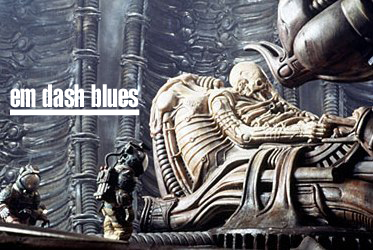
em dash blues

I recently watched Aliens for the first time. This came on the heels of me watching Alien for the first time. You know those things that just happen in youth by not happening? This is one of those things. The Alien movies never made their way into our house’s orbit, where sillier and more-action-less-horror movies found themselves watched and rewatched ad delirium. I am perhaps the world’s greatest Quick Change scholar, though I would gladly learn at the feet of another. I certainly remember it better than Bill Murray does.

Aliens just doesn’t feel really feel like a sequel to Alien. It feels like using the pieces of an antique dresser to make a working flamethrower. Aliens is more of an explodey dubstep remake, but a pretty good one. It pairs with popcorn and a giant screen. Alien gets you wherever you are, because it’s too careful not to.

One of the problems of italicizing the first use of a movie title in a blog is that I feel compelled to italicize the rest. And, look, I love italicizing after the fact, but if I am thinking about it when I start, I’m going to do it. No one would probably notice if I didn’t, including me. Maybe they should only be used for non-proper nouns. Real points of emphasis. Or maybe they shouldn’t be used at all, like semicolons. Or sparingly, like em dashes. Em dashes are catnip for narcissists. It’s a shame, because used sparingly and correctly, it can be deadly. Aliens vs. Alien.

Why the Heat will win: LeBron’s quiet coronation

The Coronation of LeBron James has been relatively quiet. In retrospect, none of what happened between the Celtics and Heat, or even the Heat and Thunder will be thought of window dressing to James’ ascension to the throne. When he does, the iceberg will break, and LeBron James will get better, and that’s all we’ll care about. See: Michael Jordan and Shaquille O’Neal and Peyton Manning and John Elway. That’s the scary part. We forgot that James has time to learn. He has tried, and he has learned, and there’s nothing more to learn. We won’t really remember the rest. It’ll still be history. It just won’t be the history. The history starts now, because the Heat lose to discipline. It’s why they lost to the Mavs, and why the Celtics give them such a hard time, and why the Spurs would have been a total nightmare, if the playoffs had taken place two weeks earlier. They beat chaos, which is why they beat Derrick Rose.

It is not just the baggage of Seattle that weighs the Thunder down. The baggage of Seattle actually provides cover for its stalker act with Westbrook and Durant. James Harden is just a fascinatingly fascinating player and dude of distinction. And how a guy named Scott Brooks who looks and acts exactly a hockey coach is a basketball coach. And how Nate Robinson played there, and the tiny chaos remains.

The Heat pretty obviously had problems last year figuring out the Wade/James dynamic, and it was a major source of problems. Age has taken care of that. Dwyane Wade is now the Heat’s No. 2 player by any measurement, except “jersey number by golf score” or “even rhymes with tree.” That was probably really it, and the problem was solved in Game Six. There’s no going back, and there’s nowhere to go but up.

Image via the amazing Coachie Ballgames